
new
what’s new
Features & Functions
Brands
Colors
wishlist


I’ve actually worn both a $1,000 ski outfit and a $100–$200 one. Of course, the $1,400 set wasn’t mine. As for the difference, the answer is obvious—it’s like heaven and earth.
But simply comparing the ceiling and the floor doesn’t really help us make better choices when it comes to ski wear. So in this answer, I’ll share some of the gear I’ve worn, grouped by brand or price range, and compare them across different tiers.
Overall, the two most important functions of a ski jacket are waterproofing and breathability. Unfortunately, these two features are inherently contradictory: waterproofing means preventing water from passing through the fabric, while breathability means allowing moisture (sweat) to escape easily. The real “high-tech” part of ski wear lies in how brands manage to balance both. Each brand has its own technical solutions and trade-offs, and as waterproofing and breathability improve, the price inevitably rises as well.
Let’s start with the cheapest piece I’ve ever bought: the neon green ski pants in the photo below. At that time, I had just returned to China for work, but all my other ski gear—except for the jacket in the photo—was still in France. When I planned a New Year’s ski trip with friends in Chongli, I figured I only needed something to get by for the trip. So, I bought these pants on Taobao for about $100–$200. I don’t even remember the brand anymore.

My overall verdict on those ski pants: fail. The problem was that they were completely non-breathable.
While the waterproofing was decent, waterproofing at the cost of zero breathability is meaningless. Sweat couldn’t escape at all, and it was completely trapped inside the pants. By the time I returned to the lodge after a full day of skiing, my thermal underwear underneath was soaked as if I had just pulled it out of water. I could literally wring it, and water would flow out—not just drip, but flow. Comfort level: zero. Honestly, even wearing jeans would have been better.
That’s why I would say the cheapest ski wear (around $100–$200) is absolutely not worth buying. If you’re a beginner trying skiing for the first time, you’re better off just wearing a pair of sports pants or hiking pants, with two layers of thermal underwear underneath. Also, bring along a spare set of dry clothes to change into afterward if you get too wet. At this stage, waterproofing really isn’t the most important factor.
The next tier up would be Decathlon’s entry-level ski wear. Although it doesn’t cost much more than no-brand gear, it’s at least basically functional—with some level of waterproofing and breathability. That said, the performance is still minimal. The waterproof rating is only 3000 mm, mostly relying on a surface water-repellent coating rather than actual waterproof fabrics. The design is also simplified, with few ski-specific features. This type of ski wear is best suited for sunny days and practicing on beginner slopes. Personally, I never bought from this tier, since I had already decided from the start that I would pursue skiing more seriously.
The next level is Decathlon’s intermediate/professional entry gear, which is where much of my current setup comes from. My Decathlon pants in this category have a waterproof rating of 8000 mm, a looser fit for comfort, large pockets for storage, and reinforced padding at the knees.
Other professional brands I’ve used in this tier include:
This level of gear is already sufficient for most skiing environments—whether sunny or snowy, on groomed runs or off-piste powder. For example, in the photo below, I was skiing in fresh powder right after a snowfall, wearing my insulated Dakine jacket. With the cuffs and collar properly sealed, I could literally roll in the snow with no issues at all.

The entry-level models from professional brands usually offer a waterproof rating of 10,000 to 15,000 mm. With this level of performance, you can literally see snowflakes bead up on the fabric and roll off instead of soaking in. Professional brands also tend to include a lot of thoughtful, practical design features—like well-placed pockets, snow skirts and gaiters to keep snow out, and even hooks designed specifically for securing keys.
That said, the waterproofing at this tier still mostly relies on surface coatings. Over time, as the coating wears out, performance drops noticeably. For example, on my now-retired Quiksilver ski pants, after about two seasons, the seat area started to ice up easily—partly because snowboarding is especially tough on that area.
Moving up to the mid-to-high-end gear from professional brands, things get much more advanced. At this level, ski wear is built with specialized waterproof-breathable fabrics, with each brand using its own proprietary technology. The most famous of these is, of course, Gore-Tex. Thanks to these advanced materials, waterproof ratings typically exceed 20,000 mm.
And yes, you can really feel the difference. For instance, in heavy snow, entry-level ski wear tends to let snowflakes stick to the surface after a while, whereas higher-end gear sheds snow much better. Or, if you sit in the snow for an extended break, cheaper gear will end up with snow clinging to it, while higher-end pants or jackets stay much cleaner.
That said, in terms of pure waterproofing, the upgrade doesn’t dramatically change the actual skiing experience—since in both cases, the snow rarely soaks through to your body. The more noticeable advantage of high-end gear is in fit and functional design.
Take my only piece in this category, for example: the Quiksilver Travis Rice signature ski pants. The cut is excellent, with careful tailoring around joints for unrestricted movement. The fabric is also slightly stretchy, so no matter how you move, the pants stay comfortable and never feel tight or restrictive.
The small details are also outstanding. Every zipper has a cord pull attached for easy handling with gloves on, with the ends neatly knotted, heat-shrunk, and sealed so they’ll never fray. The pants also feature plenty of pockets, including large ones placed thoughtfully where they won’t interfere with your movements. And the list goes on.
That’s the brick-red pair of ski pants in the photo.
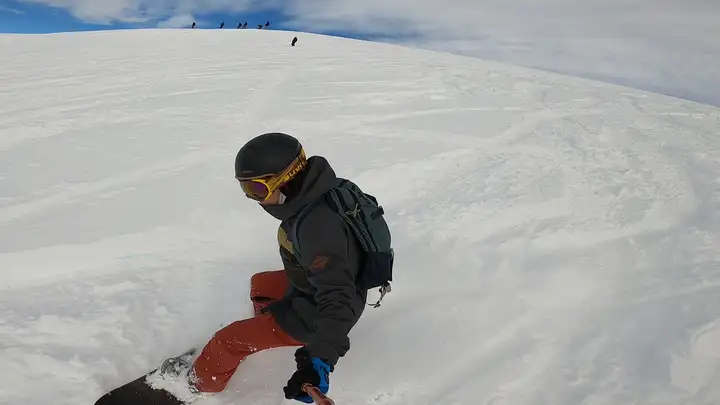
Overall, the experience at this level of ski wear is excellent—especially thanks to all the thoughtful, ski-specific design details that make it extremely convenient and practical.
As for the $1,000 gear I once tried, it was a high-end set from Arc’teryx. I got to wear it for a day or two last year while helping promote their products. My impression was that the materials were absolutely top-notch. I believe the set used Gore-Tex Pro, one of the most advanced waterproof-breathable fabrics available, with a waterproof rating of over 40,000 mm. In theory, it should keep you dry even in heavy rain. (Though I didn’t happen to ski in the rain while testing it, so I couldn’t verify that directly.)
That said, based on my past experiences skiing in rain and sleet, I can confidently say that gear rated at only 15,000 mm is not enough—you’ll get completely soaked through.
Interestingly, while the Arc’teryx set excelled in materials, I found that its design details weren’t as refined as my brick-red Quiksilver pants. Perhaps this is because Arc’teryx’s expertise is still more rooted in mountaineering and hiking gear, so they may not have quite as much experience tailoring features specifically for skiing.


